Exciting news! We’re getting ready to launch the next generation of OpenSprinkler: AC-Powered OpenSprinkler v4.0, the first built on ESP32. From the outside it looks just like v3.4 — same enclosure and same ports — but inside is an entirely new brain, with a faster processor, more memory and flash space, WiFi 6, analog inputs, native USB, and radio hardware that opens the door to Matter, Thread, and Zigbee.
Update: OpenSprinkler v4.0 is officially shipping. Order it from the Product Page.
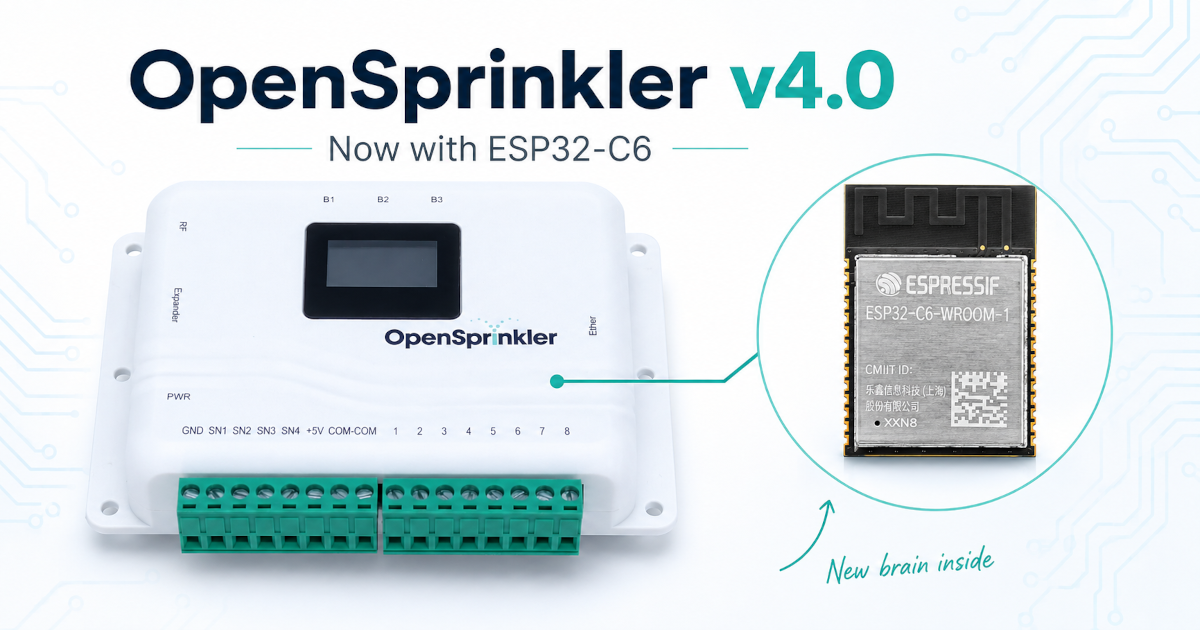
TL;DR — What’s New in OpenSprinkler v4.0?
- ESP32-C6 replaces ESP8266 – A faster and more capable MCU with substantially more RAM and flash, WiFi 6, offering better compatibility with modern routers and mesh networks.
- Improved security – Hardware-accelerated encryption and modern security features provide a stronger foundation for secure network connections.
- Built-in analog sensor inputs – Thanks to plentiful ADC-capable pins, all four built-in sensor ports (SN1–SN4) can be individually configured as either digital or analog input (0–3.3V).
- Built-in USB-C port – Native USB CDC means no separate USB-serial programmer needed for firmware recovery or debugging.
- Matter / Thread / Zigbee-ready – ESP32-C6 is equipped with a 802.15.4 radio. Firmware support for these features is planned for future releases.
- Same accessory compatibility – Fully compatible with existing Zone Expander (v3), the newly debuted Sensor Expander, and the W5500 wired Ethernet module.
Goodbye ESP8266, Hello ESP32
The ESP8266 has served OpenSprinkler remarkably well since v3.0 was released ten years ago. It is inexpensive, reliable, has built-in Wi-Fi, and remains surprisingly capable for such a small microcontroller.
But technology moves on. Espressif has officially listed ESP8266 as Not Recommended for New Designs, and many new IoT products have long since migrated to the ESP32 family.
Moving to ESP32 gives OpenSprinkler considerably more headroom. The ESP32-C6 has a 160 MHz RISC-V processor, 512 KB of SRAM, many more peripherals, ADC channels, native USB, and modern wireless capabilities. As OpenSprinkler firmware has grown over the years, we’ve added more networking features, sensor support, integrations, and increasingly sophisticated web. ESP32-C6 gives us substantially more room to continue developing these features without constantly worrying about resource constraints.
Fun Fact About Version 3.4
When I announced OpenSprinkler v3.4 last year, there was an embarrassing little truth: v3.4 was never supposed to exist! The original plan was to go directly from v3.3 to v4.0, with v4.0 being the first ESP32-based OpenSprinkler.
The problem was deciding which ESP32.
You see, when ESP8266 arrived, it had no variants. The decision was a no-brainer because there was nothing else to choose. ESP32, on the other hand, has close to a dozen variants, so many that they’re organized into whole series: S, C, H, P. Usually, having choices is a good thing. Having too many choices, however, causes confusion and exhaustion — evaluating all of them and working out which was best for OpenSprinkler took me a lot of reading and several rounds of prototyping.
I eventually settled on the C6, because it hits a sweet spot: ample GPIOs, plenty of memory and processing power, WiFi 6, hardware-accelerated encryption, and the 802.15.4 radio. It doesn’t have the raw horsepower of the S series, and it lacks the 5 GHz WiFi of the C5 — but neither matters much for a sprinkler controller, so those were easy trade-offs to accept.
The result of all that deliberation was roughly a year of delay, and v3.4 became the transition release that filled the gap. Classic paralysis by too many choices. But I’ve finally caught up, and OpenSprinkler v4.0 is just around the corner!
Questions You May Have
Q: When will v4.0 be available?
A: OpenSprinkler v4.0 is officially shipping. Order it from the Product Page.
Q: What about the OpenSprinkler DC and Latch models?
A: DC v4.0 is in development and expected to be ready by January 2027. There’s no immediate plan for a v4.0 Latch due to its relatively small demand. We will continue evaluating demand and revisit it in the future.
Q: Will v3.4 or v3.3 still be available?
A: v3.4 is a transition version and will no longer be offered once it sells out.
v3.3 will continue to be available as a replacement board (without enclosure) for repairs and DIY projects.
Q: Will v4.0 use different firmware?
A: OpenSprinkler will continue using a unified firmware codebase, so the source is the same. However, because v4.0 has a different microcontroller, the compiled binary is different. To avoid confusion, automatic firmware download and flashing will be provided as a software feature.
Q: Will you keep releasing firmware updates for v3?
A: Yes. The ESP8266 is older but still very capable, with plenty of RAM and flash headroom, and firmware development will continue for all v3 versions (v3.0–v3.4). Advanced features that depend on v4 hardware — built-in analog sensor inputs, Matter/Thread/Zigbee — will be v4-only.
Q: Can I reuse my existing Expanders and the W5500 wired Ethernet module?
A: Yes. v4.0 is fully compatible with Zone Expander v3, the recently released Sensor Expander, and it uses the same W5500 wired Ethernet module as v3.4/v3.3.
Q: Does v4.0 support 5 GHz Wi-Fi?
A: No — the ESP32-C6 is 2.4GHz only, though it does support WiFi 6 (802.11ax) and WPA3 on that band. This is a good fit for an IoT device like OpenSprinkler, where 2.4 GHz generally provides better range and wall penetration.
Q: Can I power v4.0 using the onboard USB-C port?
A: The USB-C port is used for firmware recovery (in the case of a corrupted firmware) or debugging. While it can provide power to the logic board, you still need a 24VAC transformer to operate solenoid valves.
Q: Given it has built-in analog sensor inputs, do I still need the Sensor Expander?
A: It depends on how many sensors you need. OpenSprinkler v4.0 has four built-in sensor ports, and each can be configured as either a digital or analog input. This means existing digital sensors, such as rain or flow sensors, will reduce the number of ports available for analog input. The Sensor Expander provides 16 additional analog input channels, independent of the four built-in sensor ports. So if you need more analog inputs, or want to keep the built-in ports available for digital sensors, the Sensor Expander is still the way to go.
Q: Do I need to upgrade to v4.0?
A: If your existing OpenSprinkler is working well, there is no need to upgrade just for normal sprinkler operation. v4.0 mainly provides a newer processor with more resources, analog sensor inputs, native USB, and support for future features that the v3 hardware cannot provide.
Q: I just bought an OpenSprinkler AC v3.4. Can I exchange it for v4.0?
A: Yes, as long as your purchase was made within 30 days, which qualifies under our no-questions-asked return and refund policy (see our terms and conditions).
No latch version? I’m just about to overhaul my whole system with Hunter latch and open sprinkler and a Hunter flow meter. (Wrings hands).